
Living room wall art: what actually works above a sofa
By Amy Byrne · · 6 min read
The living room is the wall people get wrong most often — usually by hanging something far too small. Here is the sizing maths, the layouts that work, and how to match art to a warm Irish room.
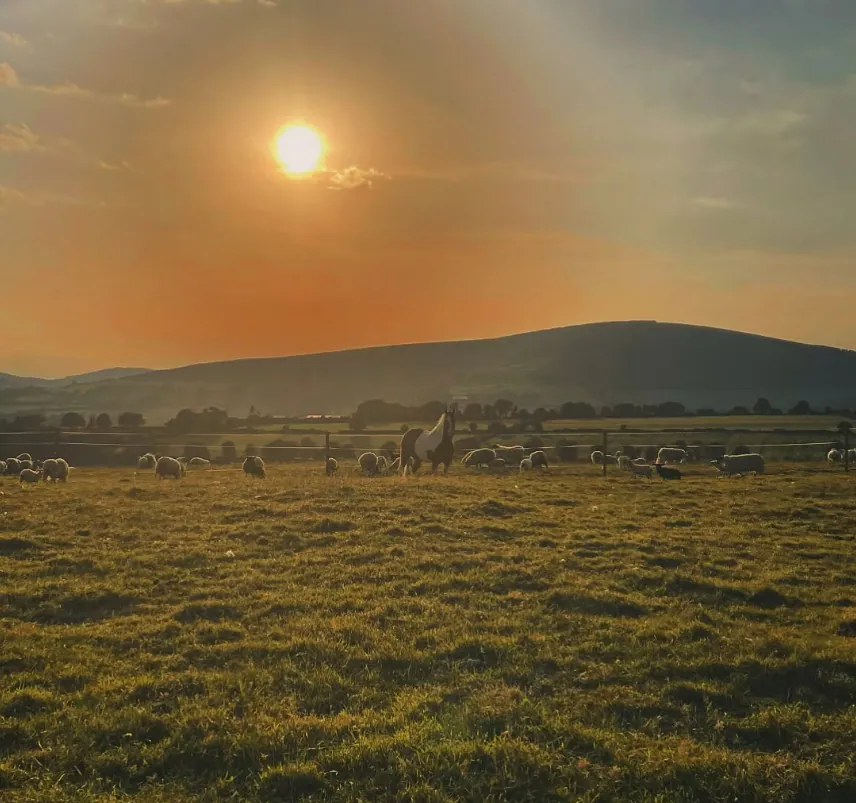
The living room is the wall most people get wrong, and almost always in the same direction: the print is too small. A 5×5″ over a three-seater sofa looks like a stamp on an envelope.
The two-thirds rule
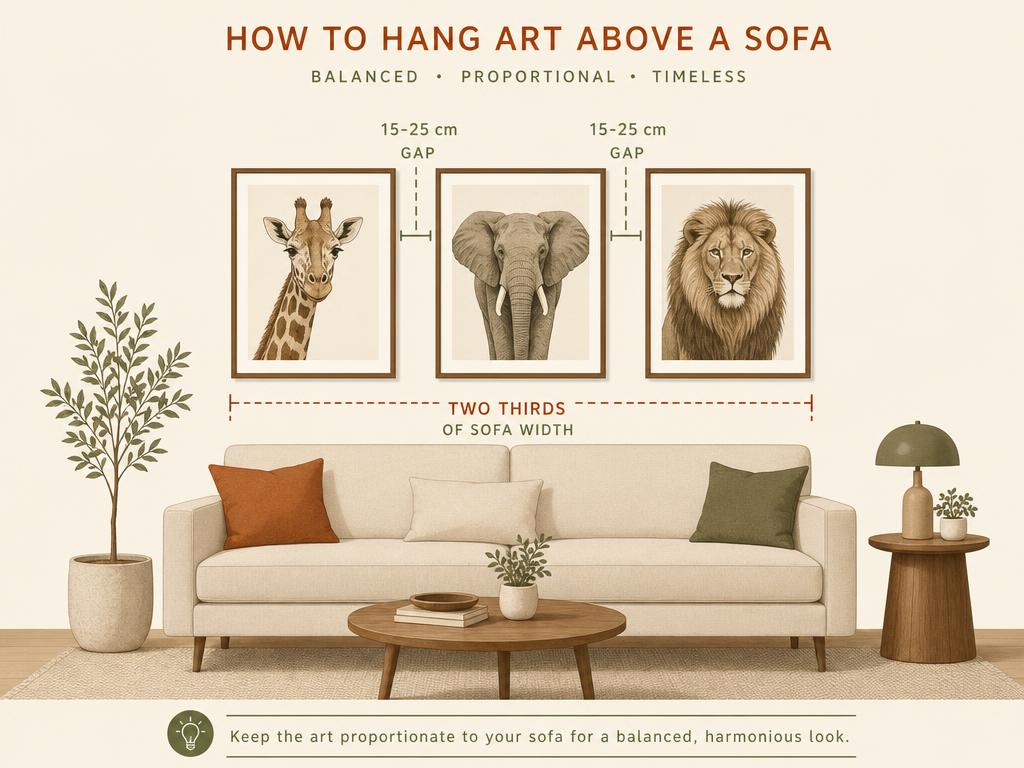
Artwork above a sofa should span roughly two thirds of the sofa's width. A standard three-seater is about 200 cm wide, so you are looking for 130–150 cm of artwork.
| Sofa width | Target artwork width | What that looks like |
|---|---|---|
| 150 cm (2-seater) | ~100 cm | One 16×24″, or two 12×16″ side by side |
| 200 cm (3-seater) | ~135 cm | Three 12×16″ in a row, or two 16×24″ |
| 240 cm (large) | ~160 cm | Three 16×24″, or a six-print grid of 8×10″ |
Leave 15–25 cm between the top of the sofa back and the bottom of the frame. Any more and the two stop reading as one group. The full method is in the hanging height guide.
One big print or three?
One big print is calmer, cheaper to hang and much harder to get wrong. If you are undecided, this is the answer.
Three in a row gives you rhythm and lets you tell a small story — three horses, three roads, three dogs. Keep the spacing identical (5–8 cm) and the frames identical.
A grid of six suits a wide wall in a room that is otherwise plain. It is more work, but see the gallery wall guide for the paper-template trick that means you only drill once.
Matching a warm Irish room
Most Irish living rooms are warm-neutral — cream, sand, muted green, a lot of natural wood — under grey daylight for eight months of the year.
- Warm-toned photographs (golden-hour fields, sunset horses) lift a room on a dull day. They are the safest choice against cream or sand walls.
- Cool greens and greys suit a room that already has strong warm colour in the sofa or rug, where another warm piece would fight it.
- Black and white solves almost every colour clash. Any image in the shop can be printed in black and white at no extra cost.
- Dark walls (navy, forest, charcoal) need a light-toned image and a light frame edge, or the print disappears.
What it costs
Prints start at €10 unframed and go to €50 for a 16×24″, with framing in oak at +€15. Three 12×16″ framed prints — a proper living room wall — comes to €135, excluding postage. That is less than a single mass-produced canvas in most Irish homeware shops, and nobody else has the same picture.
Where to start
- Horse wall art — the strongest images for a big wall
- Landscape prints — quieter, good above a sofa
- Dog wall art
- The full shop
Half of every order goes to Forever Home Sanctuary, where most of these animals live.
Frequently asked
- What size wall art should I hang above a sofa?
- Aim for artwork spanning about two thirds of the sofa's width. Over a 200 cm three-seater that is roughly 135 cm of artwork — three 12×16″ prints in a row, or two 16×24″ prints.
- How far above the sofa should the picture hang?
- Leave 15–25 cm between the top of the sofa back and the bottom of the frame, so the sofa and the artwork read as a single group rather than two separate things.
- Should I hang one large print or several smaller ones?
- One large print is calmer and harder to get wrong. Three matching prints in a row give more rhythm but need identical frames and identical 5–8 cm spacing to look deliberate.
- What colour art suits a cream or sand living room?
- Warm-toned photographs such as golden-hour fields and sunsets work best against cream and sand. If the room already has strong warm colour, choose cooler greens and greys, or a black-and-white print.
More guides
- Wall art room by room: nursery, home office and hallway
Which prints suit a nursery, a home office and a hallway — sizes, subjects, heights and colours for the three rooms people leave until last.
- How to photograph your dog (and get one worth framing)
Practical dog photography tips — get down low, use the right light, freeze movement, keep their attention, and how to tell if a phone photo will print well.
- Irish landscape photography: chasing light in a country with none
How to photograph the Irish landscape in bad light — golden hour, the twenty minutes after rain, blue hour, and which conditions actually print well.