
How to hang a picture properly (the 145 cm rule)
By Amy Byrne · · 6 min read
Most pictures in Irish homes are hung too high. Here is the gallery standard, the fixings that actually hold in plasterboard and block, and how to space prints above a sofa or up a stairs.
Almost every picture I see in a home is hung four to six inches too high. It is the single easiest thing to fix, and it costs nothing but a pencil and a tape measure.
The 145 cm rule
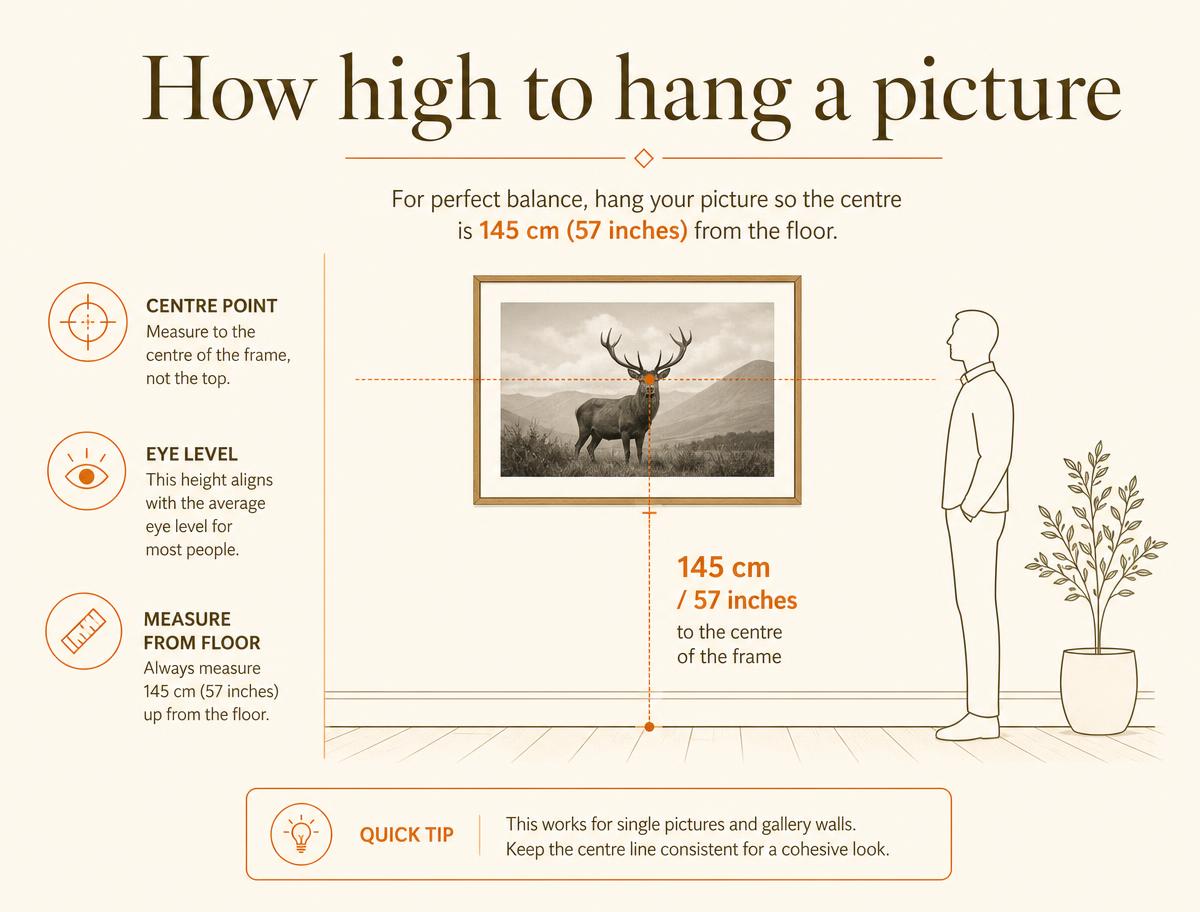
Galleries hang work so that the centre of the picture sits 145 cm (57 inches) from the floor. That is roughly average eye level for a standing adult, and it is the reason gallery walls feel calm — everything shares one invisible horizon line.
Measure to the centre of the frame, not the top and not the hook. To work out where the hook goes:
- Measure the height of the frame and halve it.
- Add 145 cm. That is where the top of the frame lands.
- Pull the hanging wire taut and measure from the top of the frame down to the wire.
- Subtract that distance. Mark the wall. That is your nail.
| Print size | Frame height (approx.) | Hook height from floor |
|---|---|---|
| 5×5″ | 20 cm | 152 cm |
| 8×10″ | 32 cm | 158 cm |
| 12×16″ | 48 cm | 166 cm |
| 16×24″ | 70 cm | 177 cm |
Those hook figures assume a wire that sits about 5 cm below the top of the frame — check yours before you drill.
When to break the rule
- Above a sofa or a bed. Ignore eye level and work from the furniture: leave 15–25 cm between the top of the sofa back and the bottom of the frame so the two read as one group.
- Low ceilings. Older Irish cottages and dormer rooms often have 2.3 m ceilings. Drop the centre line to 140 cm so there is breathing room above the frame.
- A stairway. Follow the pitch of the stairs rather than the floor. Stand on each step, mark 145 cm from that step, and your prints will climb at the same angle as the handrail.
Fixings that hold in Irish walls
Most Irish houses are block with a plaster skim, or timber-stud plasterboard in extensions and attic conversions.
- Block or brick: a 6 mm masonry bit and a red wall plug. Overkill for a 5×5″, essential for a framed 16×24″.
- Plasterboard: never a bare nail. Use a self-drive plasterboard anchor (rated ~20 kg) or hit a stud.
- Old lime plaster: stick masking tape over the mark before you drill so the surface does not blow out.
- Renting? Adhesive strips will carry an unframed print or a small 5×5″ framed piece. They will not reliably carry glass at 12×16″ or larger.
Two hooks, not one
A single hook lets a frame swing every time a door closes. Two hooks spaced about a third in from each edge keeps a print level for years — and it spreads the weight, which matters for glazed frames.
Get the print right first
Height only fixes so much. A print that is too small for the wall will look lost no matter how carefully you measure — see the print size guide for the sizes that suit each room, and browse the full shop if you are still choosing an image.
Frequently asked
- How high should you hang a picture?
- Hang it so the centre of the picture is 145 cm (57 inches) from the floor. That is the gallery standard and matches average standing eye level. Measure to the centre of the frame, not the top or the hook.
- How high should a picture hang above a sofa?
- Leave 15–25 cm between the top of the sofa back and the bottom of the frame. Above furniture, work from the furniture rather than the 145 cm rule so the picture and sofa read as one group.
- How do you hang pictures on a stairway wall?
- Follow the pitch of the stairs instead of the floor. Stand on each step, measure 145 cm up from that step, and mark. The prints will then climb at the same angle as the handrail.
- What fixing should I use for a framed print in a plasterboard wall?
- Use a self-drive plasterboard anchor rated to about 20 kg, or fix into a timber stud. A bare nail will pull out of plasterboard, especially with glazed frames at 12×16″ and larger.
More guides
- Wall art room by room: nursery, home office and hallway
Which prints suit a nursery, a home office and a hallway — sizes, subjects, heights and colours for the three rooms people leave until last.
- How to photograph your dog (and get one worth framing)
Practical dog photography tips — get down low, use the right light, freeze movement, keep their attention, and how to tell if a phone photo will print well.
- Irish landscape photography: chasing light in a country with none
How to photograph the Irish landscape in bad light — golden hour, the twenty minutes after rain, blue hour, and which conditions actually print well.